

I Tested Whether AI Can Actually Sell Your Products. Mostly, It Can't.
Hi! I'm Shrivi. I'm a Channel3 intern, I'm 19, and I cannot remember the last time I started a purchase on Google (I'm too indecisive to choose between options). Instead, I ask an AI. So does most of my generation: 61% of Gen Z shoppers used AI to help with a purchase in the past year.
So I ran a little experiment. I shopped the way my whole generation now shops, by typing a real, specific request into ChatGPT, Perplexity, and Google, and then I checked whether the AI could actually sell me anything.
A lot of the time, it couldn't. And every time it failed, it was a brand quietly losing a sale it will never see.
TL;DR
When I shopped with AI like a real customer, it sent me to resellers instead of brands, recommended the wrong sizes and colors, and even made up a product name. AI recommends from your structured product data, not your website, so if your catalog isn't clean, current, and AI-readable, you're invisible at the exact moment people buy. Channel3 gets your catalog AI-ready and onto every AI platform. Free to start.
Why this matters
The way people shop changed faster than most catalogs did. AI search queries now average around 23 words, versus 3 to 4 for a Google search. Nobody types "white sneakers" anymore. They type the whole situation: budget, size, color, vibe, where they're wearing them.
And here's the part that should make every brand nervous. When a shopper stacks all of that into one prompt, the AI has to reason across every constraint at once, and that's exactly when it stops pulling real products and starts inventing plausible-looking ones. The more specific the shopper, the more confidently wrong the answer. The brands that get skipped are the ones whose data the AI couldn't cleanly read.
The test
I gave all three engines the exact prompt I'd actually type, the kind any real customer would:
I just started a startup internship in NYC and I'm commuting and walking around the city a lot. I need shoes under $120 that are comfortable enough to walk miles in but still look put-together for a casual startup office. I'm a 19-year-old guy, my shoe size is 11, and I want the shoes to be white. What should I get and where can I buy them?
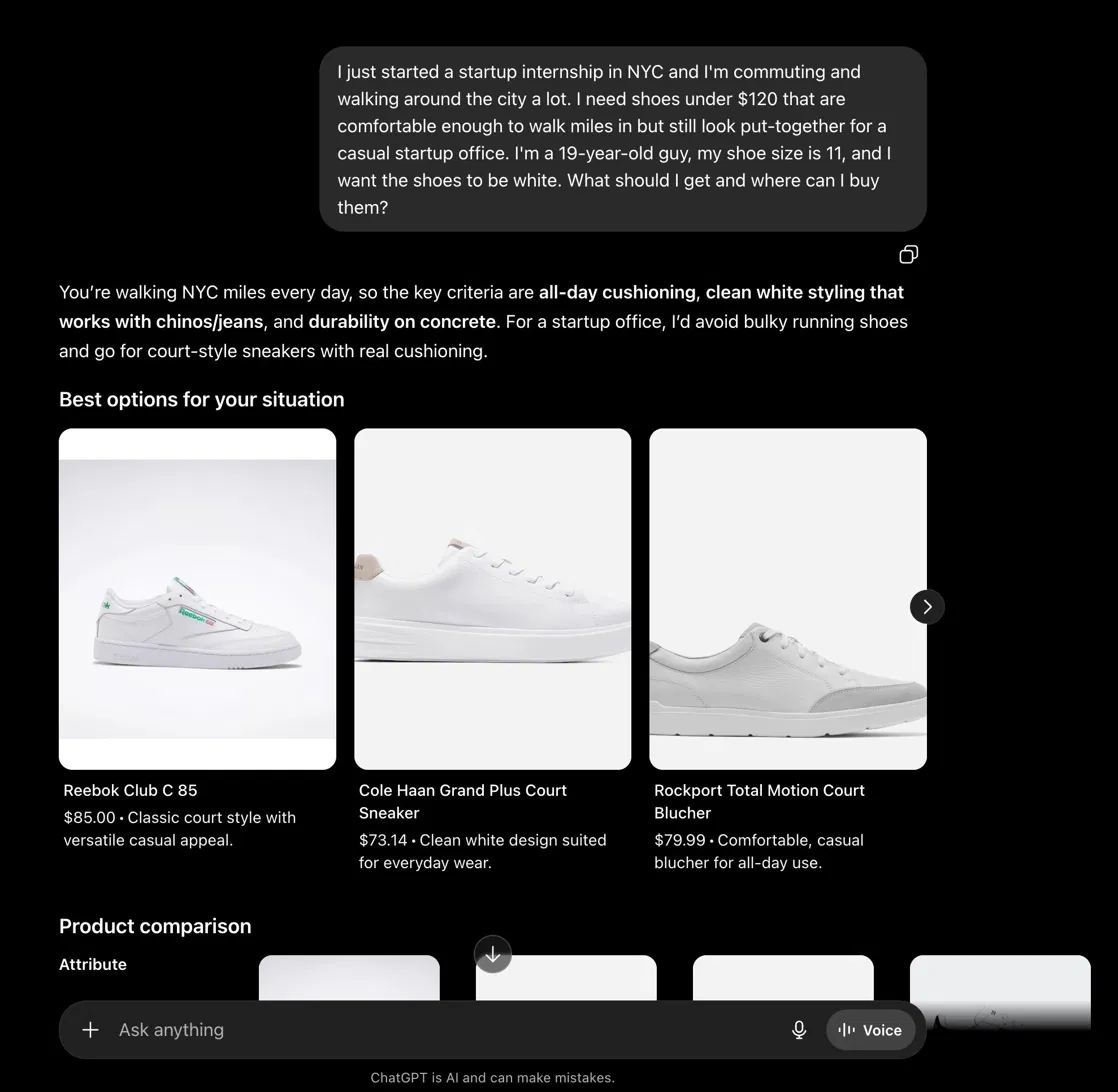
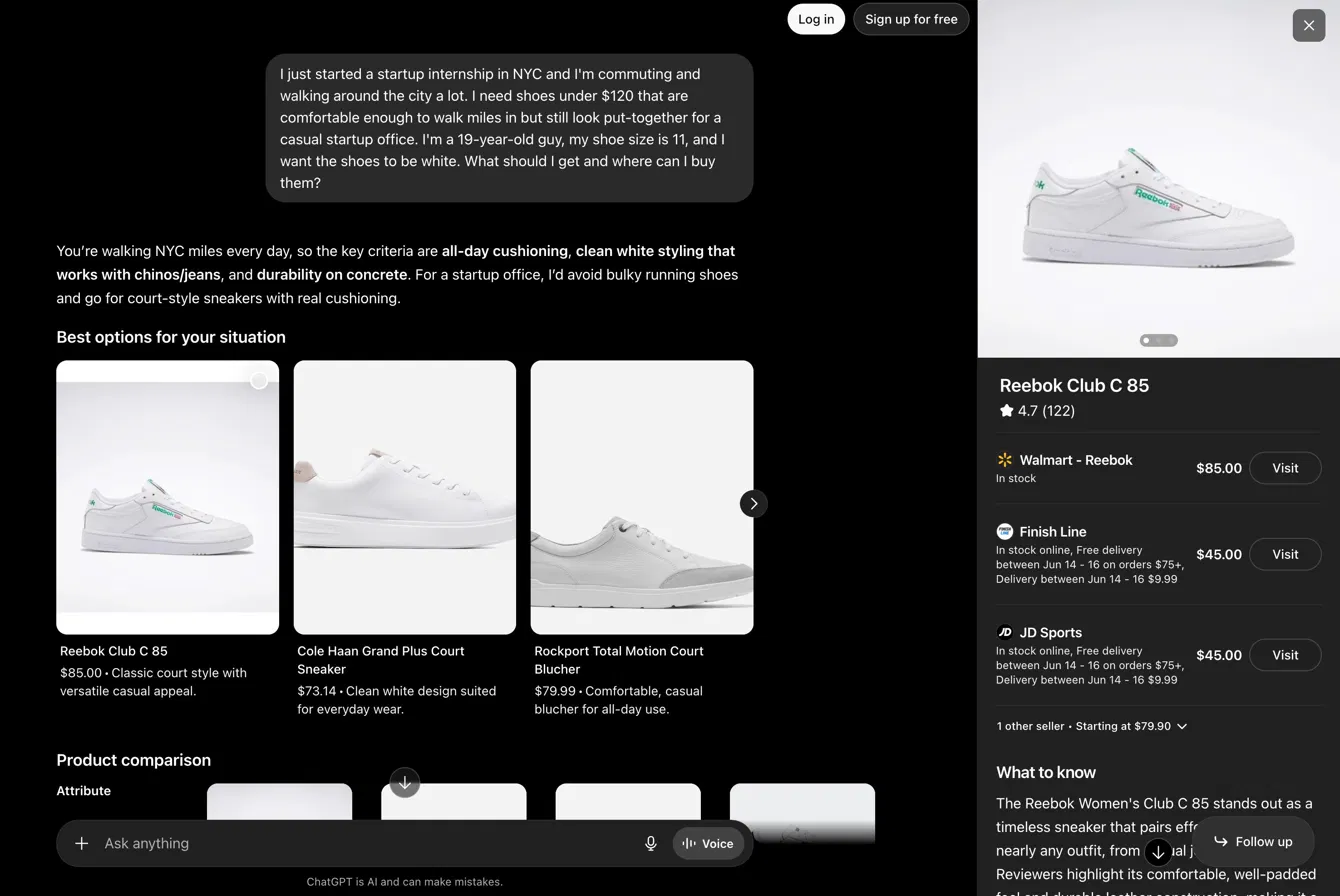
I ran it identically on each one, then clicked through every product to check whether it was real, the right color and size, in stock, and correctly priced. Three things stood out.
1. Every link went to a reseller, never the brand
Not one of the three engines linked to the brand's own store. Every "where to buy" pointed somewhere else. The Reebok pick routed to Walmart, Finish Line, and JD Sports. The Nike routed to Nordstrom Rack, DSW, and Rack Room Shoes. So even when the AI nailed the recommendation, the brand lost the click, the margin, and all control over how its product was priced and described. Someone else closed the sale.
2. One engine couldn't sell me anything at all
Perplexity didn't give me a single product I could buy. Just vague brand names with price ranges ("Adidas Grand Court or similar"), no real product links, and a source list full of women's roundups and random blogs. When I clicked its top source, the page threw a security warning and wouldn't even load. That's not a recommendation. It's a guess with footnotes.
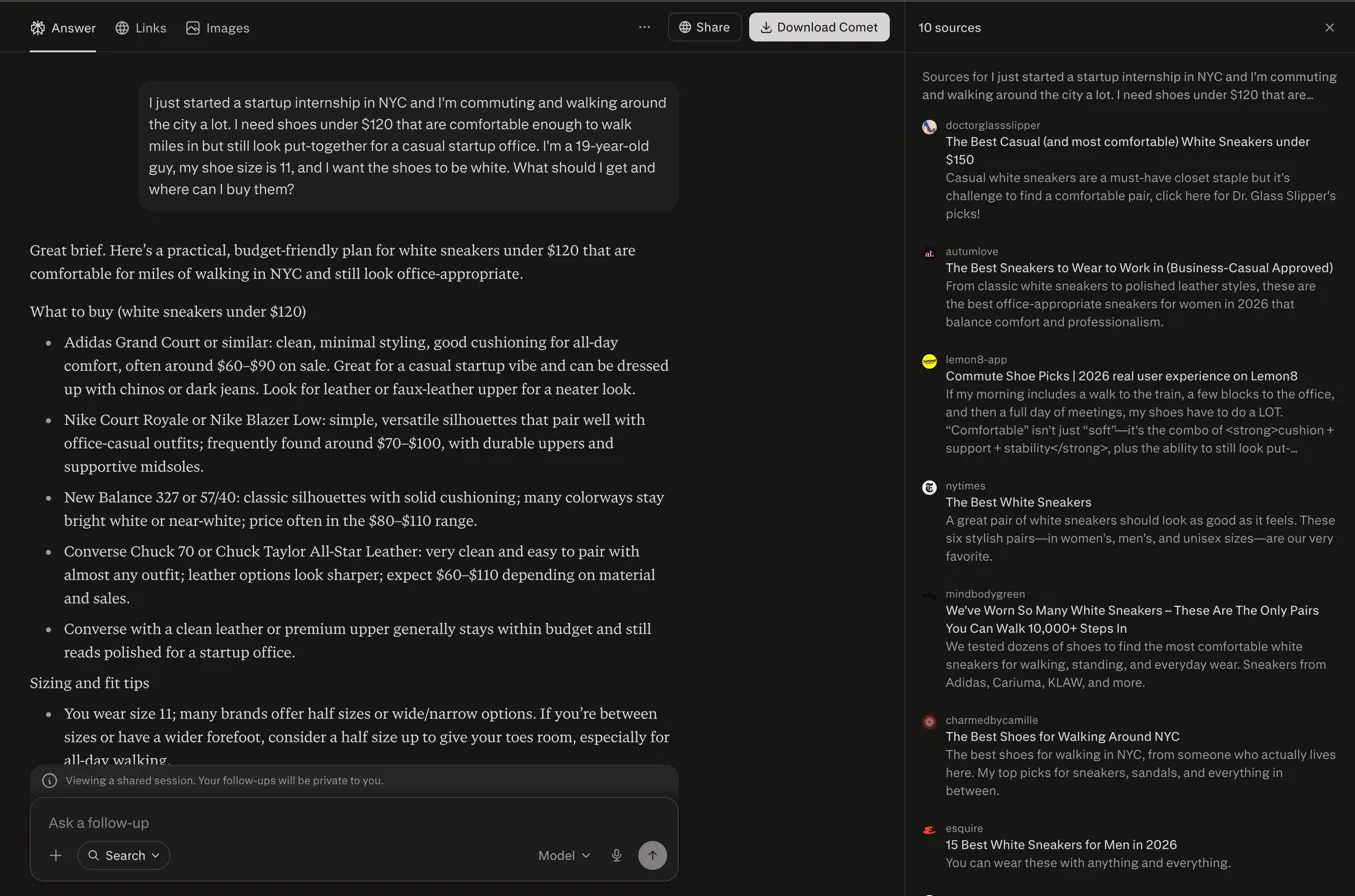

3. It got my size, my color, and even the product name wrong
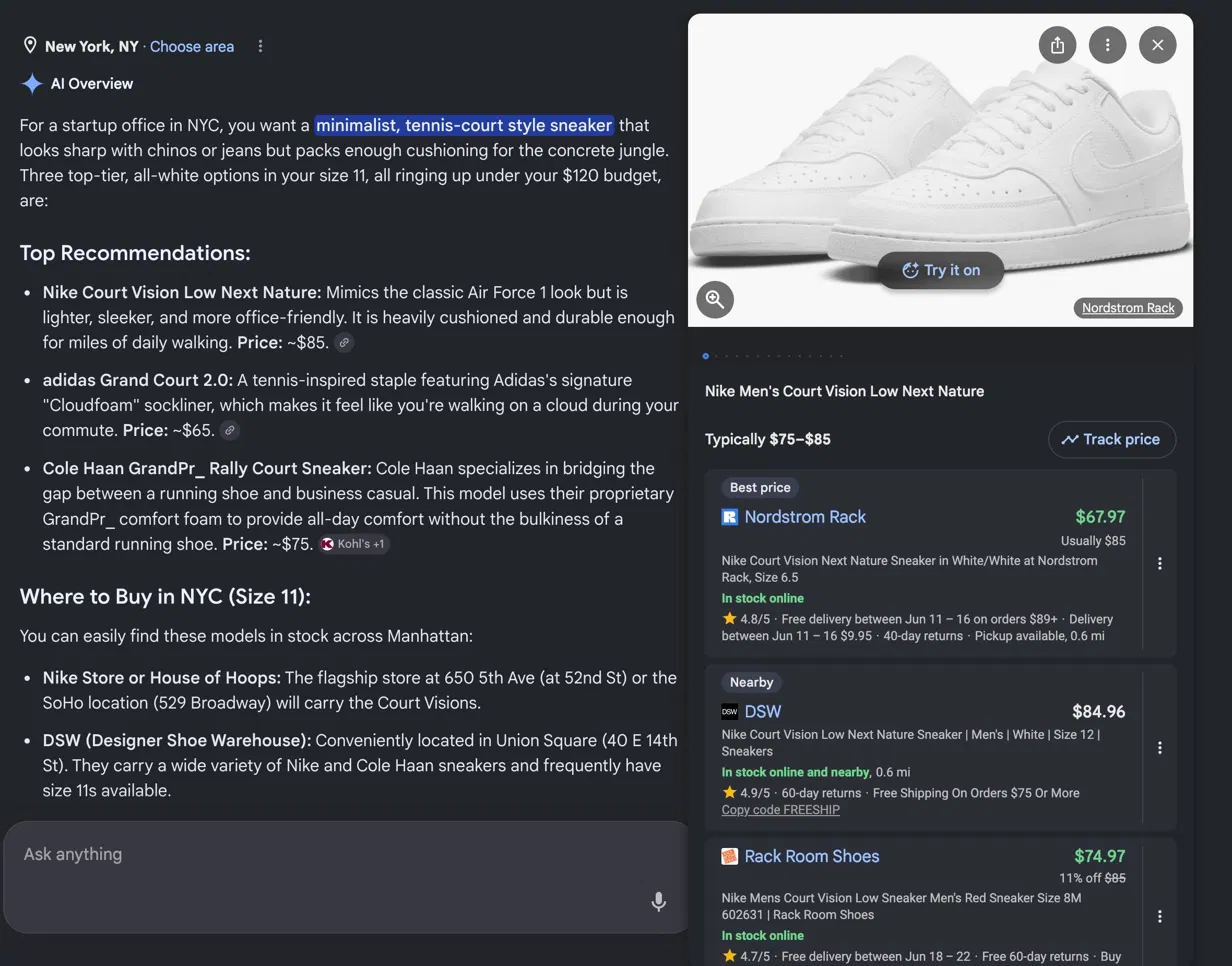
My request could not have been simpler: white, size 11, men's. Google's purchase options came back with a size 6.5, a size 12, and a red size 8.
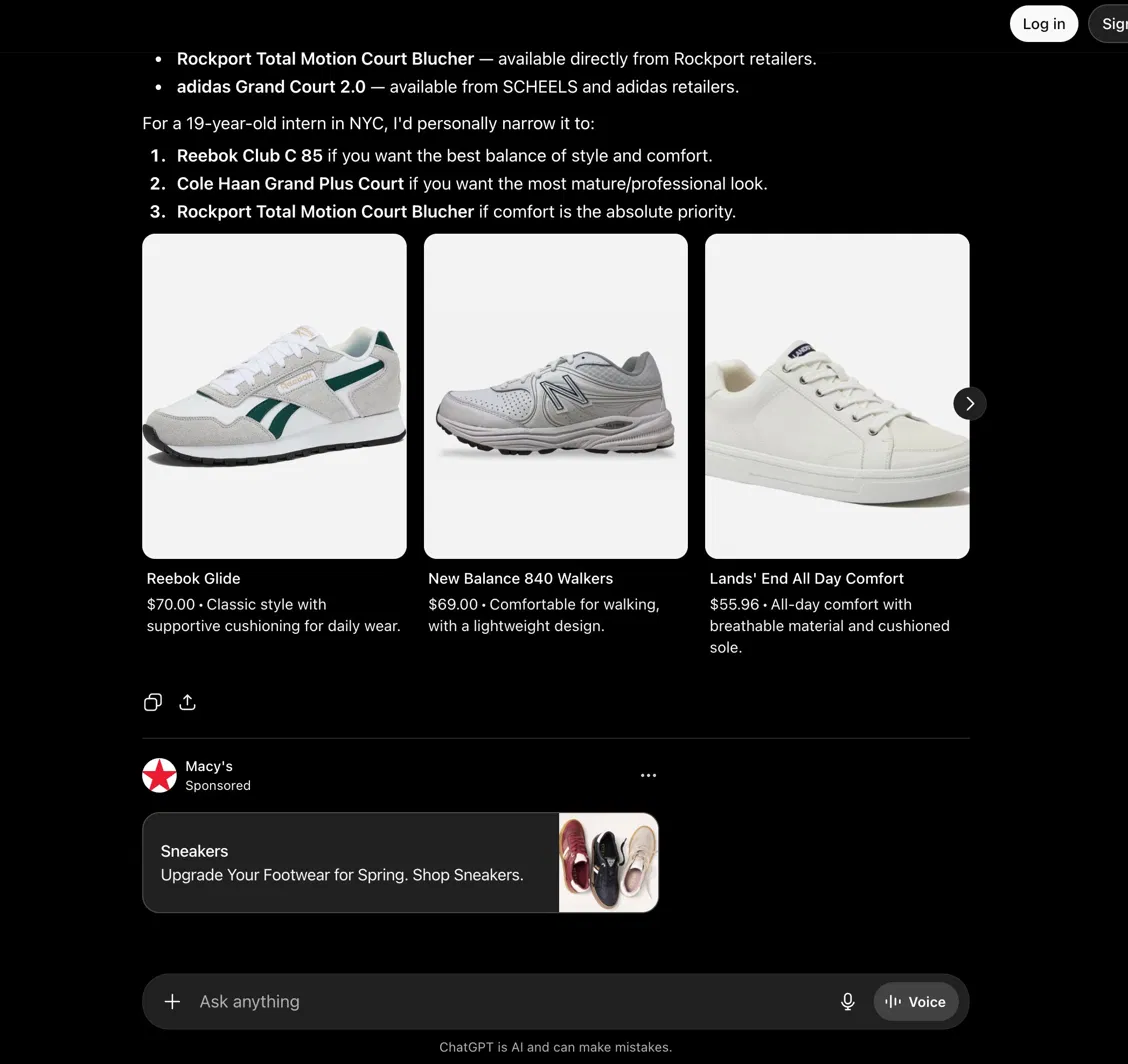
ChatGPT, meanwhile, told me to "narrow it to" three shoes and then showed me three completely different ones, plus a sponsored ad. It also quoted one shoe at $85; the link sold it for $74.95.
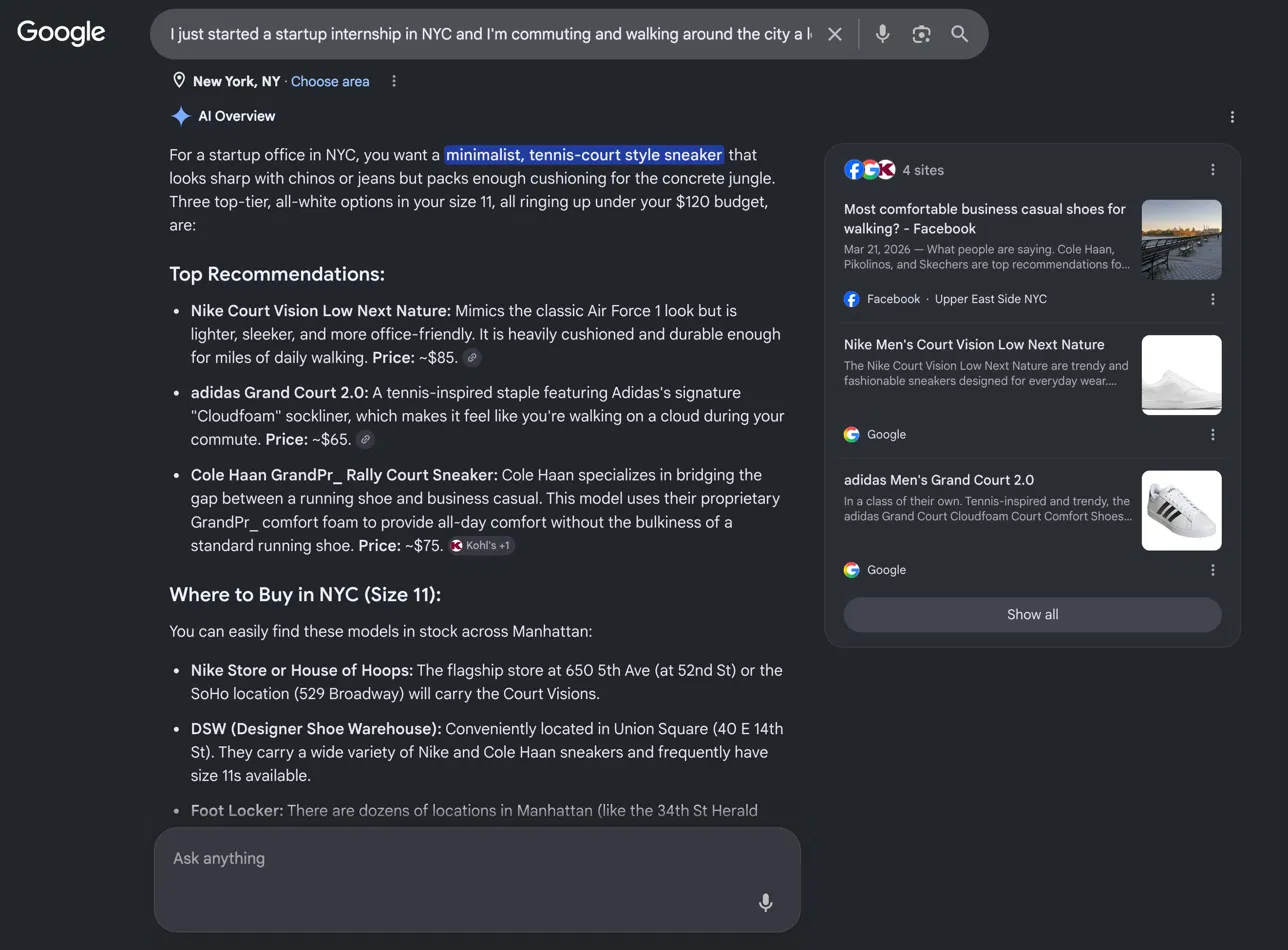
Then there was the Cole Haan. Google confidently recommended a "Cole Haan GrandPr_ Rally Court Sneaker." That shoe does not exist by that name.
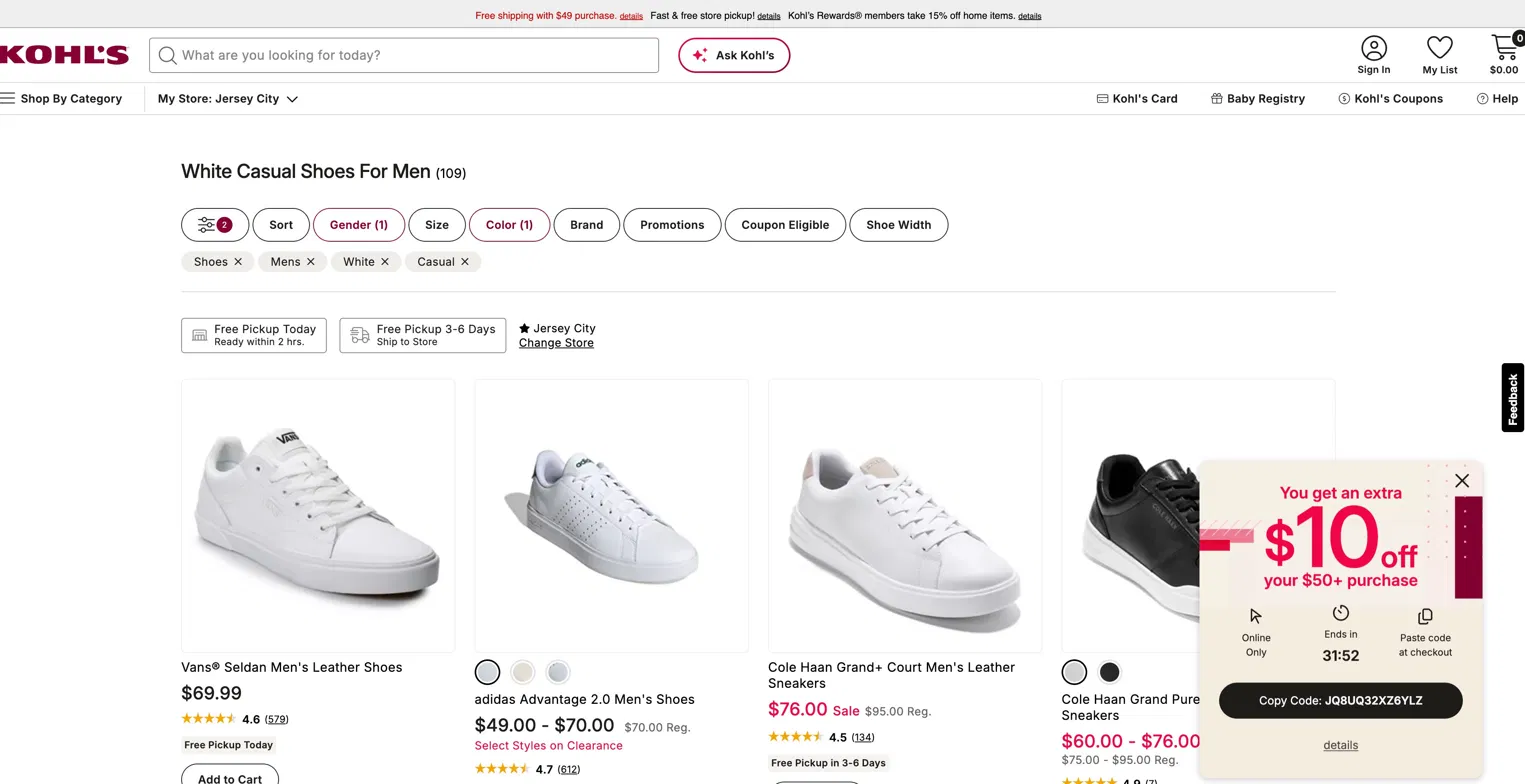
When I followed where it pointed, the "where to buy" wasn't even a product page. It was a generic Kohl's list of 109 white men's shoes, and one of its sources was a Facebook post where another guy was asking the exact question I'd typed. The real shoe, the Cole Haan Grand+ Court, was sitting in that list at $76, but Google had renamed it, dropped me on a category page, and never once pointed me to Cole Haan. When I finally dug out the real product, my size was sold out and the page defaulted to 11.5.
For the record, this isn't just me. A 2026 benchmark study, AgenticShop, documented "URL hallucination" as a recurring failure, and in April, WIRED caught ChatGPT inventing WIRED's own product picks across three categories. I just watched it happen with shoes.
How the three did
| ChatGPT | Perplexity | Google AI Mode | |
|---|---|---|---|
| Recommended specific, real products | Yes | No (vague names) | Yes |
| Gave a working buy link | Yes | No | Yes |
| Linked to the brand's own store | No | No | No |
| Right size and color at the link | Yes (the one I bought) | N/A | No |
| Correct product name | Yes | N/A | No (made one up) |
| Price matched the link | No ($85 vs $75) | N/A | Hidden / ranges |
Every reseller link, every wrong size, every made-up name was a shopper with money out, ready to buy, who got handed someone else's product, a dead end, or a category page. That's not a quality problem. It's a data problem, and it's invisible to you unless you go looking.
"But the shopper just fixes it"
Fair objection, and I'd raise it too. When the AI got my size wrong, I just changed it at checkout. I'm still the one clicking buy, so who cares?
Two problems with that. First, "just fix it" assumes the AI got everything else right: that it recommended a real product, gave you a working link, and dropped you on that exact product page. In my test it kept breaking that chain. Google sent me to a 109-item category page instead of a product. Perplexity gave no product link at all. Half the time there was nothing clean to fix.
Second, wrong data doesn't merely inconvenience the shopper, it kills the sale before checkout. 53% of shoppers say they've abandoned an online purchase because the product data wasn't correct, per Akeneo's 2025 survey of 1,800 shoppers, and more than a third have returned something over bad sizing, misleading images, or wrong details. A wrong price, a wrong image, or a "size 11" that's really an 11.5 doesn't get patiently corrected. It gets abandoned, and the shopper buys from whoever's data was right.
And the human safety net is disappearing anyway. Google's Universal Commerce Protocol already lets agents complete a purchase on a shopper's behalf, and its Universal Cart is rolling out across Search and the Gemini app this summer, with OpenAI, Mastercard, Visa, and Stripe building the same checkout rails. Soon the agent won't hand you a list to correct. It'll just buy: the wrong size, the wrong color, a product that doesn't exist, or from a reseller, with no human to catch it.
Why isn't AI recommending your products?
Three reasons, and none of them are about how good your products are.
It reads data, not web pages. AI doesn't scroll your site. It queries structured product data and matches attributes. Research on retail catalogs found a single missing GTIN is enough for an agent to skip a product entirely.
Messy data gets guessed at. Unlinked variants, blank specs, and vague titles force the model to fill gaps, so it grabs a competitor, garbles your model name, or routes to whichever reseller's feed happened to be cleaner than yours.
Stale data breaks the sale at the worst moment. Old prices and stock mean you get recommended and then lose the shopper at the link, in the wrong size or at the wrong price. Even OpenAI scaled back its checkout feature partly over missing real-time inventory data.
The trap underneath all three: being known by AI isn't the same as being recommended by it, accurately and buyably. The gap between the two is your product data.
Try it yourself (2 minutes)
Don't take my word for it. Open ChatGPT, Perplexity, or Google AI Mode and type the messy, specific prompt your customer would actually use. Then check: do your products show up, are the details right, and do the links go to a live, in-stock page that's yours and not a reseller's? If you're missing, wrong, or routed somewhere else, that's your data not being readable to the systems now deciding what gets bought.
How to make your products AI-ready
Most of this isn't a website rebuild. It's:
- Clean, structured data: clear titles, complete specs, linked variants, proper categories
- Stable identifiers (GTINs) so agents match a query to your exact SKU
- Real-time price and availability, so you aren't recommended and then sold out at the link
- Distribution across every AI surface (ChatGPT, Google, Copilot, Perplexity, and the new AI shopping apps), formatted the way each one expects
- Control over how you appear, so agents describe you right instead of inventing a name
- Tracking from AI query to checkout, so you can see what's working
How Channel3 fixes this
That checklist above isn't a coincidence. It's exactly what Channel3 does for brands, end to end. Connect your store once, and we turn your catalog into the clean, real-time, AI-readable data those systems need, put it in front of shoppers across Google, Microsoft, OpenAI, and the platforms coming next, and give you control over how you appear, plus tracking from the first AI query to checkout.
Every failure in my experiment, the reseller links, the wrong sizes, the shoe that didn't exist, came down to the same thing: messy or missing product data the AI had to guess around. Channel3 removes the guesswork, so AI recommends your actual product, at the right price, in the right size, linked to you.
Get listed for free and see exactly how AI shoppers find you today. When you're ready, scale across every major platform on the Premium Plan. Most brands are set up in about 10 minutes, with no rebuild and no engineering lift.
The shoppers are already here, and the agents are about to start checking out on their own. The only question is whether your data is clean enough for AI to pick you, or whether it picks the brand that was easier to read.
Get your catalog AI-ready, free
— Shrivi, Intern @ Channel3
Newsletter
Get new posts in your inbox
Field notes from the rapidly changing world of AI commerce