

Channel3 vs Tinyfish
TL;DR: TinyFish is a web automation platform built for AI agents. It lets developers use natural-language instructions to navigate websites, extract information, and execute workflows. It also offers search, fetch, and browser APIs for different types of web access. It is a strong fit for agents that need to interact with websites and complete multi-step tasks.
Channel3 is a structured product database purpose-built for commerce: 100M+ products across 25,000+ retailers, normalized product data, continuously refreshed prices and availability, and monetization built in.
If your agent needs to navigate websites and execute workflows, TinyFish is a strong choice. If it needs to search, compare, and recommend products across retailers, Channel3 provides a ready-to-query product catalog. The two can also work together.
Different tools, different jobs
TinyFish’s pitch is to make the web accessible to AI agents. Its Agent API takes a natural-language goal and executes the browser actions needed to complete it. Developers can use it to navigate websites, click through pages, extract structured information, and automate workflows without writing every interaction themselves. TinyFish also provides Search, Fetch, and Browser APIs for developers who need different levels of control.
That makes TinyFish useful for a wide range of tasks, including shopping. An agent could visit a retailer, extract product details, compare information across websites, or navigate a checkout flow. TinyFish’s documentation includes examples of extracting product names and prices from ecommerce pages.
The distinction is how the product data is obtained. TinyFish gives developers the infrastructure to interact with websites and extract information from them. Channel3 gives developers access to a product catalog that has already been collected, normalized, and made searchable.
For a shopping agent, that can remove a significant amount of work. Instead of navigating multiple retailer websites, extracting product details, reconciling variants, and maintaining product records, developers can query Channel3 for structured results across its catalog.
Channel3 returns product records with prices, availability, variants, images, merchant offers, and commission data where relevant. Its search API supports natural-language and image queries, while its lookup API can return structured metadata from a product URL.
TinyFish is useful when an agent needs to do something on a website. Channel3 is useful when an agent needs to know what products are available and present them in a shopping experience. For developers building more advanced commerce agents, both capabilities may be useful.
Channel3 vs. TinyFish
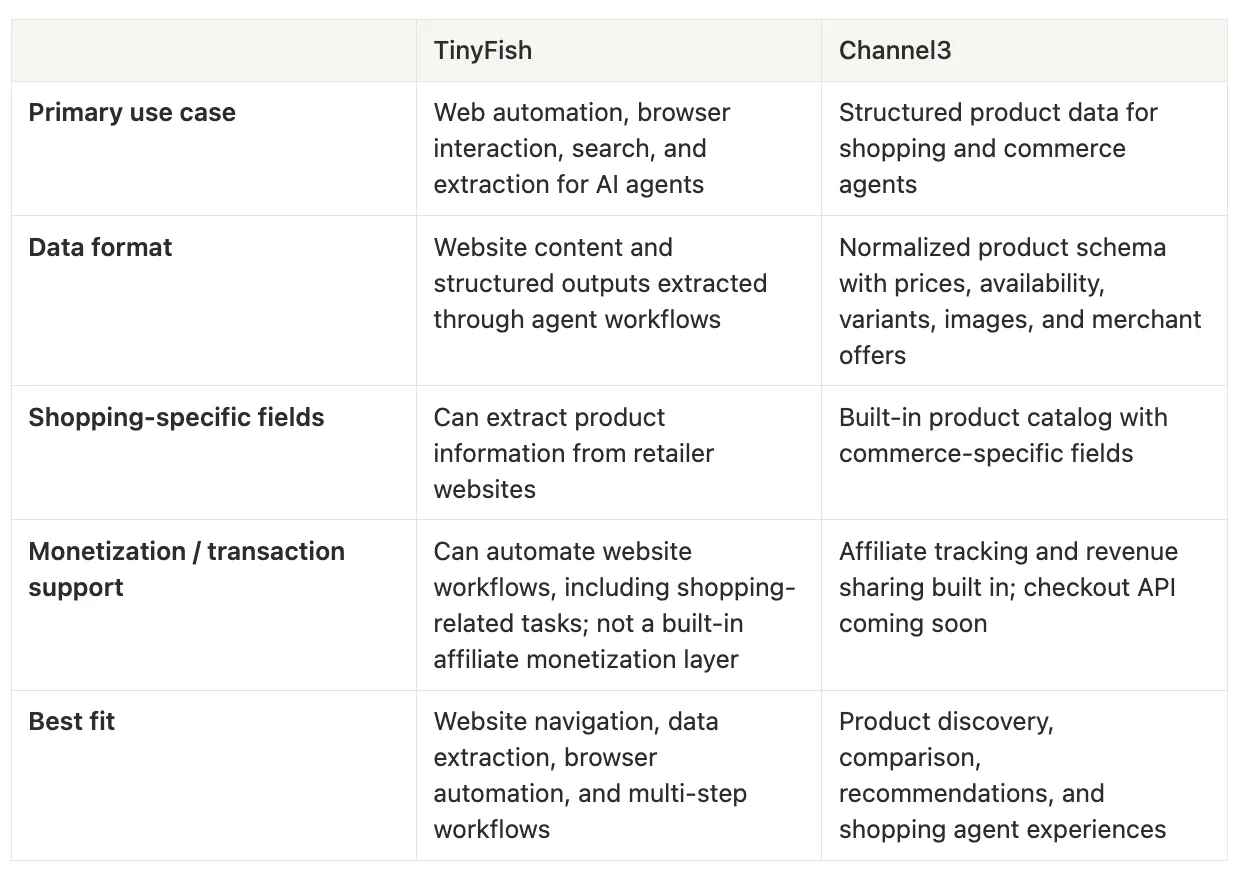
TinyFish’s official documentation supports its browser automation and structured extraction capabilities; Channel3’s developer documentation supports its catalog and monetization capabilities.
Primary use case — TinyFish: Web automation and browser interaction for AI agents. Channel3: Structured product data for shopping and commerce agents.
Data format — TinyFish: Website content and structured outputs extracted through agent workflows. Channel3: Normalized product records with prices, availability, variants, images, and merchant offers.
Shopping-specific fields — TinyFish: Can extract product information from retailer websites. Channel3: Product-specific fields are built into a searchable catalog.
Monetization / transaction support — TinyFish: Can automate shopping-related website workflows, but does not provide a built-in affiliate monetization layer. Channel3: Affiliate tracking and revenue sharing built in, with checkout infrastructure in development.
Best fit — TinyFish: Website navigation, data extraction, and multi-step browser workflows. Channel3: Product discovery, comparison, recommendations, and shopping experiences.
FAQ
What is TinyFish used for?
TinyFish is a web automation platform for AI agents. It lets developers use natural-language instructions to navigate websites, extract information, and execute workflows. It also provides search, fetch, and browser APIs for different types of web access.
Is TinyFish a good fit for shopping or ecommerce AI agents?
Yes. TinyFish can be used to navigate retailer websites, extract product information, and automate shopping-related workflows. However, developers who need a searchable product catalog across many retailers may prefer a purpose-built product data API rather than extracting and maintaining that information themselves.
What is an alternative to TinyFish specifically for product and shopping data?
Channel3 is a structured product database purpose-built for commerce. It provides access to 100M+ products across 25,000+ retailers, with normalized product data, merchant offers, and built-in monetization infrastructure.
Can TinyFish and Channel3 be used together?
Yes. Channel3 can provide product discovery and structured product data, while TinyFish can handle website interactions or workflows that require browser automation. For example, an agent could use Channel3 to find and compare products, then use TinyFish for a website-specific task that requires navigation or interaction.
What is the difference between a product API and a web automation API?
A product API provides structured information about products, such as prices, availability, variants, images, and merchant offers. A web automation API lets an agent navigate websites and execute actions. Product APIs are useful for discovering and comparing products at scale, while web automation APIs are useful for interacting with websites and completing workflows.
Newsletter
Get new posts in your inbox
Field notes from the rapidly changing world of AI commerce