
Channel3 vs SerpAPI
TL;DR: SerpAPI’s shopping data comes from scraping Google’s search results — data Google is actively fighting to lock down, legally and technically. Channel3 gives you the same coverage through a normalized, purpose-built product database instead, with no scraping risk attached.
Google is fighting back
SerpAPI’s core business is scraping Google (and other) search results and returning them as structured data. This is becoming increasingly difficult:
1. Legal. Google filed suit against SerpAPI in December 2025. A court granted SerpAPI’s motion to dismiss in July 2026, but Google came back with an amended complaint in August 2026, and the litigation continues. On top of that, Reddit filed its own suit against SerpAPI in March 2026, naming Perplexity as well, over unauthorized use of platform data.
2. Technical. Separate from the courtroom, Google has been making it harder to scrape the product data itself — routing product links through Google-hosted redirect pages, introducing new token-based identifiers for “immersive” product results, and generally making the underlying data harder to extract cleanly and consistently.
What that means if you’re building on it
If your product recommendations, comparison engine, or shopping agent depends on SerpAPI’s Google Shopping results, you’re exposed on two fronts you don’t control: a legal outcome you have no influence over, and a data source that can disappear the moment Google ships another anti-scraping change. Neither is something you can plan around.
The data itself is better, not just safer
Scraped data has a structural ceiling on quality. SerpAPI is parsing a snapshot of a search results page — a page that’s cached, that reflects whatever Google’s crawler last indexed, and that was never designed to be machine-readable in the first place. Two things follow from that:
- Freshness. A search results page reflects Google’s index, not the retailer’s live inventory. Price changes, stock-outs, and new listings all take time to propagate through Google’s crawl-and-cache cycle before they show up in a scrape. Channel3 pulls from direct retailer relationships, so price and availability reflect what’s actually true right now, not what Google happened to have cached.
- Completeness and accuracy. Parsing a search results page means working with whatever fields Google chose to render on that page, in whatever format Google’s layout happened to use that day — which breaks or goes missing whenever Google changes its page structure. Channel3’s data is normalized at the source into a consistent schema, so you’re not reverse-engineering a webpage’s HTML to guess what a field means.
That structural difference shows up in what you can actually build with the data:
- Brand search. Query by brand directly against a normalized field, not by hoping a brand name appears cleanly in scraped page text.
- Image search. Search by product image, not just text — something a scraped search results page was never built to support.
- Better filters. Filter on consistent, structured attributes (price range, category, variant, availability) instead of whatever loosely-formatted text happened to survive the scrape.
- Consistent metadata. Every product follows the same schema — the same fields, the same formats — so you’re not writing custom parsing logic per retailer or per page layout.
We’re also a direct SerpAPI replacement, not just a safer one
SerpAPI isn’t only a data source — it’s also a search API you query with a request and get results back. Channel3 offers the same thing for shopping and product queries: a search API you can call directly to get structured product results, without needing to scrape or parse anything yourself. If you’re using SerpAPI specifically for its shopping search endpoint, Channel3 is a drop-in replacement for that use case — same query-in, results-out shape, built on real data instead of a scrape.
Channel3 sits beneath your product, not in competition with it
Channel3 isn’t a search engine or a shopping destination — it’s infrastructure. Think of it as the Stripe of agentic commerce: you keep total control over the experience — your editorial, your rules, your UX — and we supply the structured product data underneath it.
This industry runs on opacity. Channel3 doesn’t — you get full visibility into the data and analytics on the backend, not a black box. And commission infrastructure is built in, so you can actually monetize the shopping experience you build, not just serve data for free.
Channel3 vs. SerpAPI
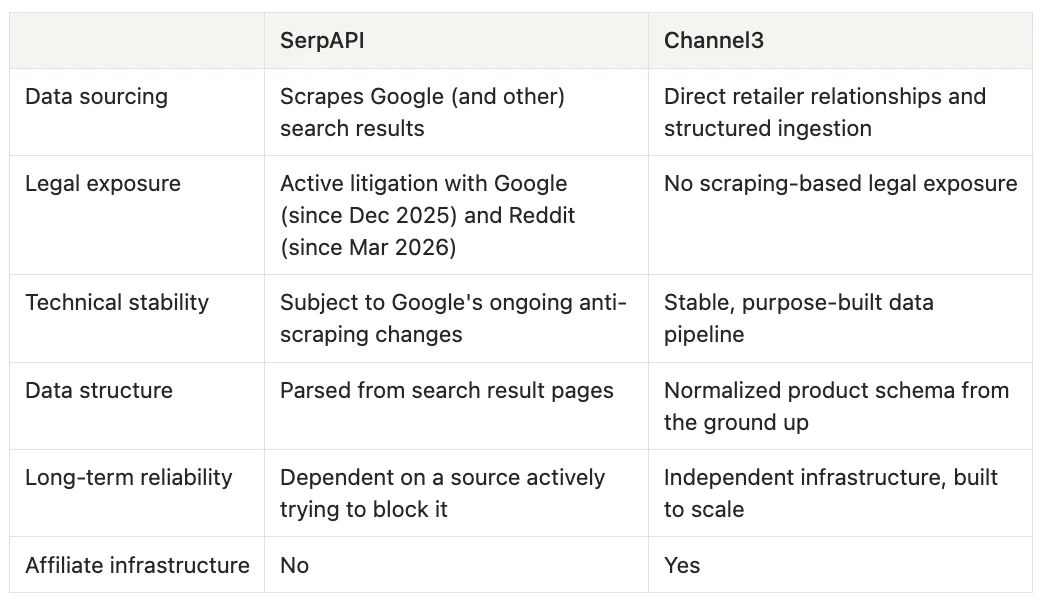
- Data sourcing: SerpAPI scrapes Google/other search results; Channel3 has direct retailer relationships + structured ingestion
- Legal exposure: SerpAPI in active litigation with Google (Dec 2025) and Reddit (Mar 2026); Channel3 has no scraping-based legal exposure
- Technical stability: SerpAPI subject to Google’s anti-scraping changes; Channel3 has a stable, purpose-built pipeline
- Data structure: SerpAPI parses from search result pages; Channel3 has a normalized product schema built from the ground up
- Long-term reliability: SerpAPI depends on a source trying to block it; Channel3 has independent infrastructure built to scale
- Commission infrastructure: SerpAPI — No; Channel3 — Yes
FAQ
What happened in the Google v. SerpAPI lawsuit?
Google sued SerpAPI in December 2025. In July 2026, a court granted SerpAPI’s motion to dismiss on part of the case, but Google filed an amended complaint in August 2026 and the litigation is ongoing. Separately, Reddit sued SerpAPI in March 2026 over similar data-scraping claims.
Is it risky to build a product on top of SerpAPI’s Google Shopping data?
Yes, for two reasons: the legal status of scraping Google’s results is actively contested and unresolved, and Google continues to make technical changes that make scraping product data harder and less reliable, independent of the litigation.
What’s a more stable alternative to SerpAPI for shopping and product data?
Channel3 provides structured product data — 100M+ products across 25,000+ retailers — built on direct data relationships rather than scraping, with no exposure to the legal or technical instability affecting scraper-based providers.
Is Channel3’s product data actually better than SerpAPI’s, not just less risky?
Yes. Because Channel3 pulls from direct retailer relationships instead of scraping search results pages, its data is fresher and more complete — with capabilities scraped data can’t reliably offer, like brand search, image search, structured filtering, and consistent metadata across every product, instead of parsing whatever a search results page happened to render.
Can I replace SerpAPI’s shopping search endpoint with Channel3 directly?
Yes. Channel3 offers its own shopping and product search API, so teams using SerpAPI specifically for shopping search can switch to a direct, structured alternative built on real data rather than a scrape.
Newsletter
Get new posts in your inbox
Field notes from the rapidly changing world of AI commerce