

How to Build an AI Shopping Agent That Returns Real Products
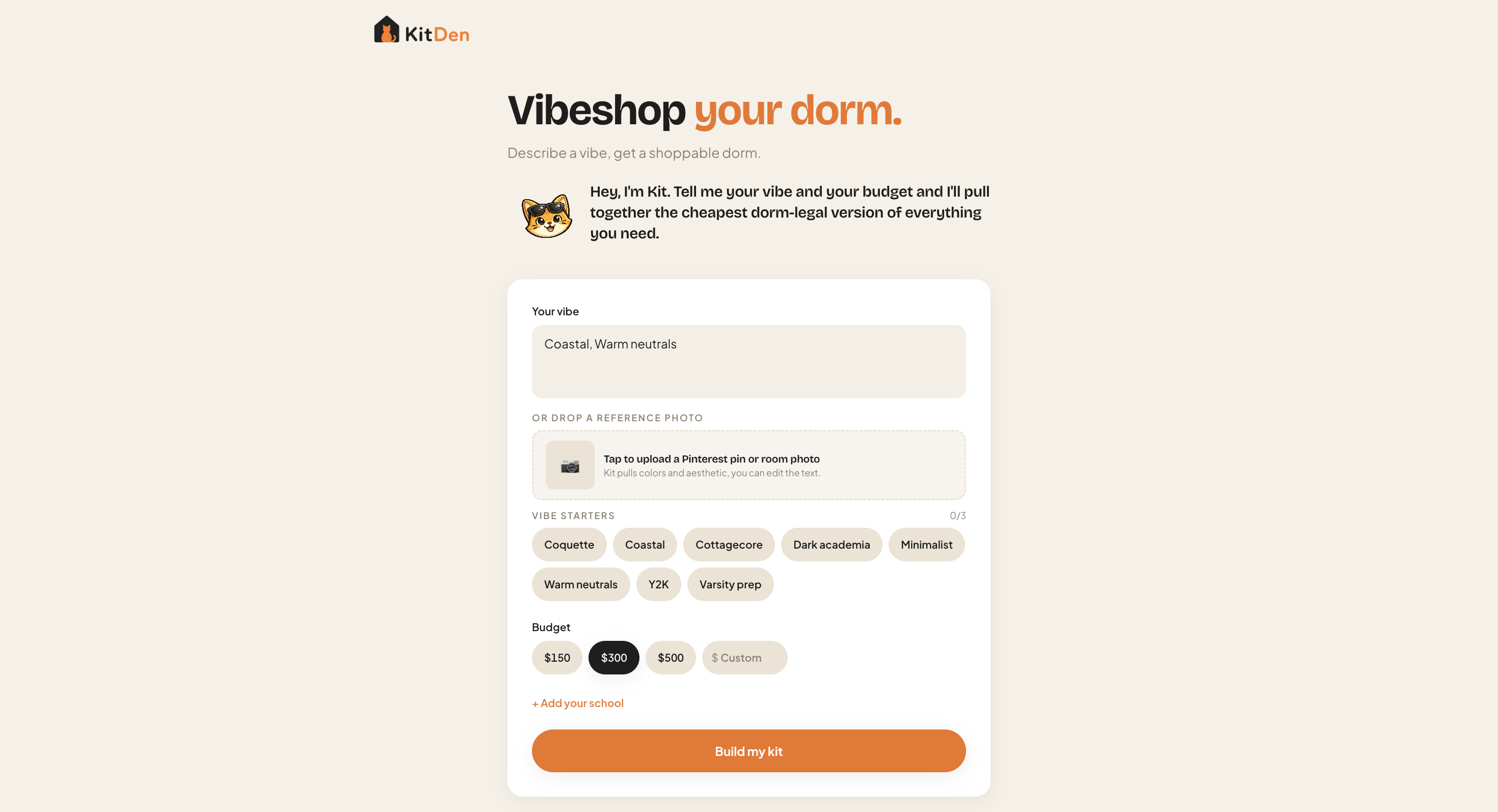
Hi! I'm Shrivi, an intern at Channel3, and a few weeks ago I built a working AI shopping app called KitDen in an afternoon. The thing that surprised me wasn't how easy the AI part was. It was how hard the other part turned out to be.
Most "how to build an AI shopping agent" guides spend all their time on the model and barely mention the part that actually breaks: getting the agent to return real products. In stock, correctly priced, with a link that genuinely buys the thing. That's the hard 80%, and it's what this guide is about.
TL;DR
The hardest part of an AI shopping agent isn't the AI. It's getting real, buyable products: in stock, correctly priced, with a working buy link, across many stores. Scraping breaks, and platform APIs only return their own inventory. The fix is a product-data API built for agents: one call returns normalized, cross-merchant products with attributed buy links, so monetization comes free. I used Channel3 (one /v1/search call, 1,000 free searches, no credit card) and had a live, earning app, KitDen, in an afternoon. The full stack and the build are below.
Why this matters
Here's the thing nobody building their first shopping agent expects: the AI is the easy 20%. Any current model can hold a shopping conversation (whether you call it an AI shopping agent, assistant, or copilot, the reasoning layer is the easy part). The 80% that actually breaks is the products: finding real ones, across many stores, with prices that are right today and links that go to a live page. And the stakes are real: 53% of shoppers say they've abandoned a purchase because the product data was wrong (per Akeneo's 2025 survey of 1,800 shoppers), so an agent that returns a wrong price or a dead link doesn't get a second chance.
I learned this the way Channel3's founders did, just secondhand. Before this company existed, our CEO Alex was building an AI teacher that recommended supplies ("learning guitar? here are some beginner guitars under $200"). Simple, except every search API he tried returned blog articles instead of buyable products. That gap was big enough to be its own company. I tested all those APIs myself in my first week, and they really are that bad for shopping.
So before you write a line of code, here's the map.
The layers of an AI shopping agent (and the one everyone underrates)
People like to draw the agent stack as model → tools → checkout → payment, and obsess over the checkout end (placing the order). That's a real problem to solve eventually. But if you're building one, you hit a wall much earlier, at the layer that's supposed to be simple:
- The reasoning layer. The LLM that reads "a warm, coastal dorm under $300," decides what to search for, and explains its picks. You already know how to do this part.
- The product-data layer. How the agent finds real products: live listings, prices, images, variants, buy links, across many merchants. This is the layer that quietly kills most first agents, and the one this guide is about.
- The interface layer. What the shopper sees: results, a product page with offers and price history, a cart.
- The monetization layer. How it earns. The twist: if your product-data layer is set up right, this one comes for free (more below).
Everyone covers the reasoning layer because it's the fun part, and the checkout layer because it sounds hard. The product-data layer in the middle is the one that actually stops you, and it's where your agent either returns real, buyable things or a wall of hallucinated listings and dead links.
And this isn't hypothetical. A 2026 benchmark study, AgenticShop, documented "URL hallucination" (agents confidently linking to products that don't exist) as a recurring failure, and WIRED caught ChatGPT inventing its own product picks across three categories. That's the product-data layer failing, not the model.
The hard layer, and how to skip the pain
The naive way to get products is to scrape: point your agent at a few retailers and parse the HTML. I almost went down this road for KitDen, and I'm so glad I didn't. Scraping breaks every time a site redesigns. It's merchant-by-merchant, so every new store is a new integration. And platform APIs (Amazon's, etc.) each return only their own inventory. You end up maintaining a pile of brittle scrapers instead of building your actual product.
The alternative is one call to a product-data API built for agents:
POST https://api.trychannel3.com/v1/search
header: x-api-key: <YOUR_KEY>
body:   { query, filters, limit }
Real products come back, normalized and deduplicated, across merchants. In the response, the price is offers[0].price.price and the buy link is offers[0].url. That offers array is the cross-merchant magic: the same product, every store that carries it, so your agent can say "that Nike backpack is $90 at nike.com or $95 at Foot Locker" instead of guessing.
Here's how the categories actually compare for this specific job (full teardown in my API test post):
| For building a shopping agent | Returns real products | Structured price + buy link | Cross-merchant | Built-in monetization |
|---|---|---|---|---|
| General web search APIs | Sometimes (unstructured) | No (buried in text) | No | No |
| SERP scraping APIs | Yes | Partial (heavy cleanup) | Google Shopping only | No |
| Shopify Catalog | Yes | Yes | Shopify merchants only | No |
| Universal product API (Channel3) | Yes | Yes | 25,000+ brands | Yes |
The bottom row is the only one with everything a shopping agent actually needs in one call. That's not me being a homer; it's the same conclusion I reached running the test before I worked on this stuff much.
The fastest way to build one
Two honest on-ramps, depending on how you like to build:
If you build in a terminal agent (Cursor or Claude Code), install Channel3's skill and components, then describe your app:
# Teach your agent the Channel3 API
npx skills add channel3-ai/skills --skill channel3-api

# Add the shopping UI (shadcn registry)
npx shadcn@latest add https://ui.trychannel3.com/r/all.json
Then prompt: "Build a shopping experience using the Channel3 skill and components — search with filters, results in a grid, click a product for a full detail page with variants and similar products." The skill keeps the agent from hallucinating the integration; the components hand it a real product page (gallery, every offer, variants, price history, recommendations) so it isn't hand-building the hard surfaces. Channel3's team says this gets you a working first version in a few prompts.
The skill is terminal agents only (Cursor, Claude Code). It doesn't apply inside prompt-builders like Lovable, which install the components by prompt instead.
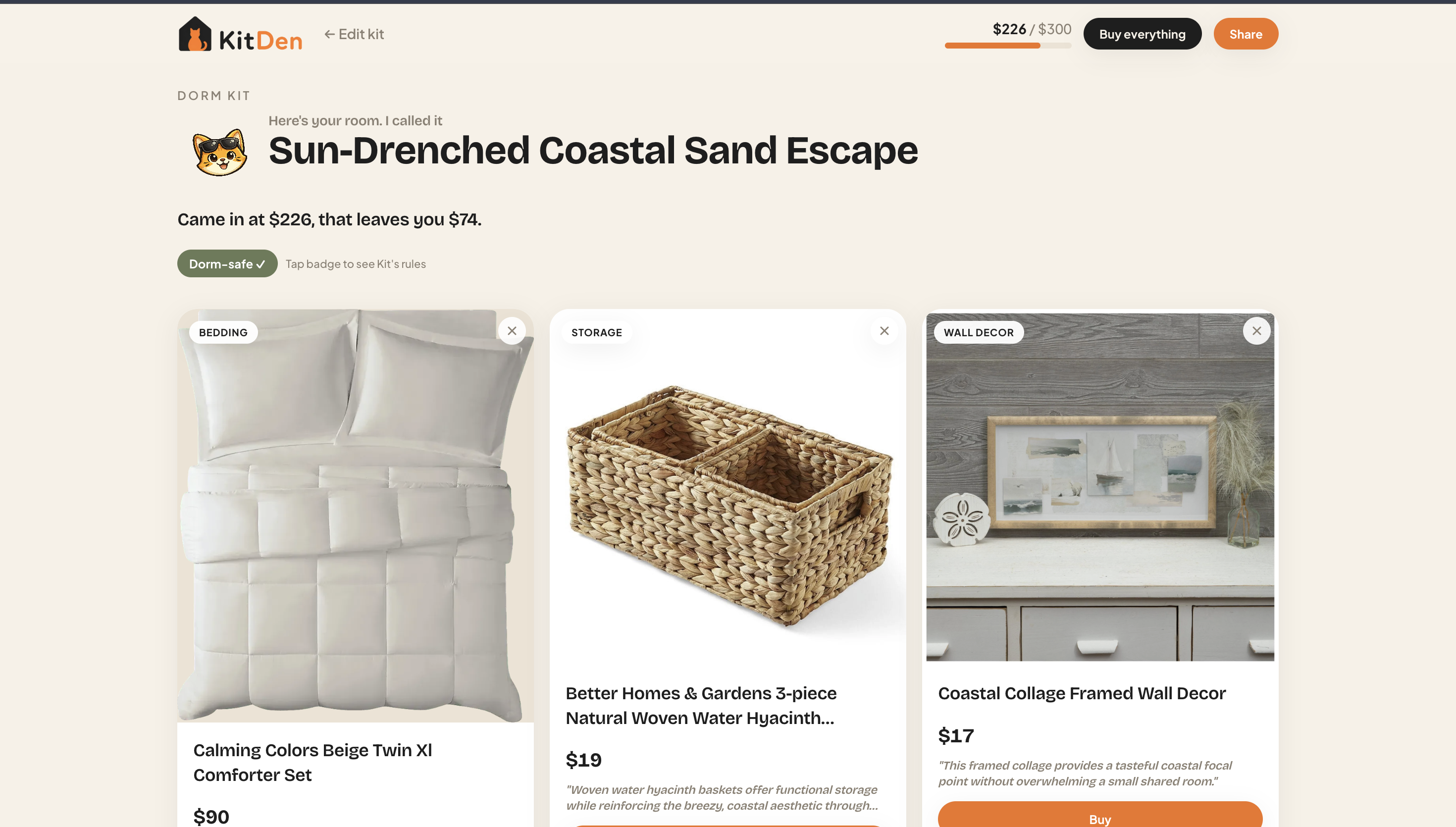
If you build in a prompt-builder like Lovable (this is how I built KitDen, with zero CLI), you describe the app in plain English and it ships. The components install by prompt; no terminal, no SDK wrestling. I wrote the full five-step walkthrough here:
→ I built a real shopping app on Lovable in 5 steps (as a non-engineer)
Either way the spine is identical: a real product-data layer instead of scrapers, real product pages instead of hand-built ones.
The part nobody tells you: monetization is free
This is the bit that genuinely surprised me, so I'll say it plainly: if your agent searches with your API key, it's already monetized.
Every offers[0].url from a keyed search is an attributed, commission-earning link. When a shopper clicks through and buys, you earn. No commission program to join, no ad network, no per-merchant deals. Channel3 holds the relationships (thousands of brands); any offer where max_commission_rate > 0 is monetizable.
The honest mechanics, so you can plan: earnings clear after the retailer's return window, payout is via Stripe, and you complete identity verification in the dashboard so commissions aren't withheld. The exact split is on the Pricing page.
Why this matters more than it sounds: most vibecoded "AI product finder" apps never crack revenue and quietly die. Building on a layer that's attributed by default means the business model is wired in from the first search. I wrote about why that changes the whole game in the build post.
A portable lesson (keep this even if you never touch Channel3)
The biggest thing I learned building KitDen: don't hand-build a hard surface until you've checked whether someone already shipped it. Standing up a dashboard? That might be Tremor. A rich text editor? TipTap. A maps view? Mapbox. For a shopping app, it was Channel3, and it didn't just save me days; it handed me features (price-history charts, cross-merchant comparison) I'd never have thought to build. The right building block doesn't just save time; it raises the ceiling on what you ship.
Try it yourself
Don't take my word for it. Grab a free key (1,000 searches, no credit card), run one /v1/search call for whatever you'd actually want to buy, and look at what comes back versus scraping. Then pick your on-ramp: Quickstart for terminal, or my 5-step Lovable build for no-code.
The agents are getting good fast. The product data is the part that's still up for grabs. Build on the right layer and the rest is genuinely a weekend.
— Shrivi, Intern @ Channel3
Frequently asked questions
- What API gives an AI agent real product data?
- A product-data API built for agents, like Channel3. One POST to /v1/search returns normalized, cross-merchant products with structured prices (offers[0].price.price) and working buy links (offers[0].url), across 25,000+ brands.
- Why does my AI shopping agent return articles instead of products?
- Because general web-search APIs return web pages, not structured products: prices are buried in HTML and there is no brand, retailer, or buy-link field. A product-data API returns real listings with prices and buy links instead.
- What's the hardest part of building an AI shopping agent?
- The product-data layer: getting real, in-stock, correctly-priced products with working buy links across many merchants. The reasoning (AI) layer is the easy part; the product data is what quietly kills most first agents.
Newsletter
Get new posts in your inbox
Field notes from the rapidly changing world of AI commerce